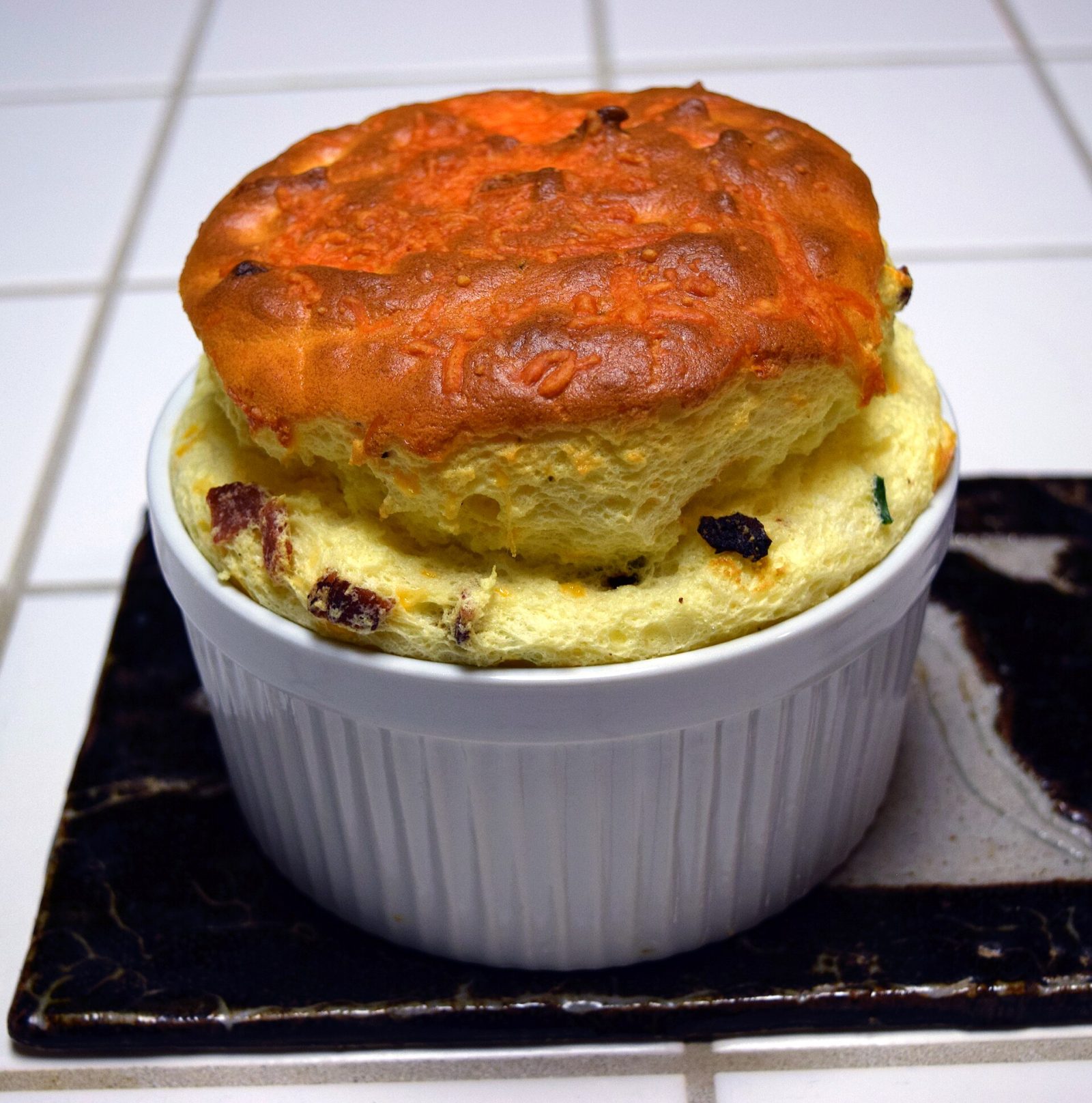
Cheese Soufflé (Soufflé au Fromage)
Declassified 22 August 2026
Threat assessment
- 1 No contact Nobody is in danger. Least of all the locals.
- 2 Light resistance A warmth. You mention it. Nobody responds.
- 3 Engaged You are sweating. No one else at the table is sweating.
- 4 Taking fire You have stopped talking. A child has taken your portion.
- 5 Operative down Extraction required. Locals describe this one as "not spicy".
A cheese soufflé is a very thick béchamel enriched with egg yolks and mountain cheese, lightened with whipped whites and baked until it climbs well above the rim of its dish. It belongs to no single region — it is the standard of the Paris restaurant and the bourgeois home kitchen alike — but it stands or falls on properly aged Comté or French Gruyère from the Jura and Savoie. A good one has a deep golden cracked crown, a wall of set but tender soufflé, and a centre still loose enough to act as its own sauce. Nothing in it is technically difficult; it is entirely a matter of a base thick enough to carry the whites, whites stopped at the right moment, and an oven door that stays shut. Photo: Mark Miller (CC BY-SA 4.0), via Wikimedia Commons.
// SUPPLY LIST
SCALE:
| AMT | UNIT | ITEM |
|---|---|---|
| 5 | Large eggs, separated — 5 whites and 4 yolks used (whites about 165 g, yolks about 72 g) | |
| 15 | g | Unsalted butter, softened to pomade, for the mould |
| 15 | g | Plain flour, for dusting the mould |
| 300 | ml | Whole milk, full fat |
| 1 | Bay leaf, fresh or dried | |
| 120 | g | Comté aged 12-18 months, French Gruyère IGP or Beaufort, grated on the fine holes of a box grater |
| 50 | g | Unsalted butter, diced, for the roux |
| 50 | g | Plain flour (T55 or all-purpose), for the roux |
| 0.5 | tsp | Fine sea salt, for the base |
| 0.25 | tsp | White pepper, freshly ground |
| 0.13 | tsp | Cayenne pepper, for savour rather than heat |
| 0.25 | tsp | Whole nutmeg, freshly grated |
| 1 | tsp | Dijon mustard, smooth |
| 0.13 | tsp | Fine sea salt, for the whites |
| 15 | g | Comté or Parmesan, finely grated, for the top |
// OPERATIONS
- 1 Separate the 5 eggs while they are still fridge-cold, when the yolks are firm and split cleanly: whites into a scrupulously clean, bone-dry bowl of glass, stainless steel or copper — never plastic, which holds a film of grease no washing removes — and yolks into a small bowl. You need all 5 whites but only 4 yolks, so set the fifth yolk aside for another use, and let not one speck of yolk fall into the whites: yolk fat coats the protein and contaminated whites will foam a little but never build to a peak, and there is no rescue but starting again with a clean bowl. Cover both and leave them on the counter for 30 to 45 minutes while you prepare the mould and the base — whites at about 20°C / 68°F whip to roughly a third more volume than cold ones, which is height you cannot get back later.
- 2 Prepare the mould next, before any cooking starts: take a straight-sided 1.5 to 1.7 litre (18 cm / 7 inch) porcelain soufflé dish and paint the inside with the 15 g of very soft butter using a pastry brush, working in upward vertical strokes from the base to the rim, then butter the rim itself. Do not smear it round in circles — the whites climb the vertical ridges of butter like a ladder, and a horizontally buttered dish gives a soufflé that sticks on one side and leans. Add the 15 g of flour, rotate and tap the dish so it coats every buttered surface, then invert and knock out all the loose excess until no pale clumps remain, since anything left loose bakes into gritty grey patches on the crust. Put the dish in the fridge until you need it, where the butter sets hard and holds its ridges.
- 3 Set a shelf in the lower third of the oven, remove every shelf above it so there is nothing for the soufflé to hit, place a heavy baking sheet on that shelf, and heat the oven to 190°C / 375°F conventional (170°C / 340°F fan) at least 20 minutes before you will need it. The preheated sheet drives heat into the base of the dish and gives the fast early lift that makes the soufflé rise straight; a half-heated oven still climbing when the dish goes in sets the crust before the air inside has expanded, and you get a dense, level top. Use conventional heat if your oven offers it — a fan dries and sets the crust too early and pushes the rise sideways.
- 4 Put the 300 ml of milk and the bay leaf in a small saucepan over medium-low heat and bring it to just below a boil, about 3 to 4 minutes, until it steams and small bubbles ring the edge but the surface is not moving. Take it off the heat, cover, and leave to infuse for 10 minutes, then lift out the bay leaf and keep the milk covered and hot — cold milk hitting a hot roux is what gives you lumps. While it infuses, grate the 120 g of Comté on the fine holes of a box grater; never use pre-grated cheese, whose anti-caking starch turns the base stringy and heavy. This is the whole of the traditional infusion in a home kitchen — the restaurant onion clouté studded with cloves is not missed here, because the cheese is loud enough to bury it.
- 5 Melt the 50 g of diced butter in a heavy 20 cm saucepan over medium-low heat and, as soon as the foaming subsides, whisk in the 50 g of flour all at once. Cook this roux for a full 2 minutes, whisking constantly, until it looks like wet sand, comes together around the whisk and smells faintly of hot biscuit rather than raw flour. Do not let it take any colour at all — a blond or brown roux gives you a dull grey-tan sauce, a nutty flavour that fights the Comté, and less thickening power, which is the one thing this soufflé cannot spare.
- 6 Take the pan off the heat and pour in the hot infused milk in three additions, whisking hard to a smooth paste after each before adding the next; the first addition will seize into a stiff lump, which is correct — keep whisking and it loosens. Return it to medium heat and whisk without stopping for 3 to 4 minutes, reaching into the corners of the pan, until the sauce thickens dramatically, pulls away from the sides in a single mass and the whisk leaves a track that holds its shape for a second or two. It will look far too thick to be a béchamel and that is exactly right — this is a panade at roughly 165 g of flour to the litre of milk, and a pourable sauce simply cannot hold whipped whites up, which is the single most common reason a home soufflé rises 2 cm and quits.
- 7 Beat the 1/2 tsp salt, 1/4 tsp white pepper, 1/8 tsp cayenne, 1/4 tsp nutmeg and 1 tsp Dijon into the hot base — the mustard is a home cook's addition rather than an Escoffier one, but it is near-universal in French kitchens because it sharpens the cheese without announcing itself. Scrape the base into a wide bowl of at least 3 litres so you have room to fold later, whisk it for a minute to let the steam out, and leave it 10 to 15 minutes to fall to about 55-60°C / 130-140°F: hot to a fingertip but no longer steaming. Whisk in the 4 egg yolks one at a time, waiting until each disappears before the next — straight off the stove they set into yellow threads you can never smooth out, but a base left to go properly cold is the worse mistake, because the cheese will then never melt into it. Stir in the grated Comté and keep stirring until the last shred has vanished and the base is glossy and stretches on the spoon, then taste and season a shade more assertively than seems right, because 165 g of unseasoned white is about to dilute it.
- 8 Whip the room-temperature whites with the 1/8 tsp of salt in their clean, dry bowl. Start slow for about 30 seconds until they are loose and foaming, then take the speed to medium-high for 3 to 4 minutes, until they are glossy and smooth and a peak lifted on the whisk stands up and then curls over at the very tip like a bird's beak, the bec d'oiseau. A copper bowl and balloon whisk are traditional, and an electric hand whisk is what virtually every French home actually uses — perfectly fine, but stop and check every 15 seconds near the end, because a machine goes from bec d'oiseau to dry and cotton-wool in moments, and dry, grainy whites will not fold in, leaving white lumps and a soufflé that rises and then splits and slumps.
- 9 Whisk a full third of the whites into the cheese base briskly and without any delicacy at all — this third is sacrificed to slacken a base that is otherwise far too stiff to accept anything gently. Add half of what remains and switch to a large flexible spatula: cut down through the centre of the bowl, sweep along the base, lift the mixture up and over from the far side, and give the bowl a quarter turn, repeating steadily. Add the last of the whites and fold about 10 to 12 more strokes, then stop while you can still see two or three faint streaks of unincorporated white — a batter folded perfectly even is a batter that has already been over-folded, and every stroke past that point is deflation. Work through the whole fold in under a minute; whipped whites begin to weep and go watery the moment they are left standing.
- 10 Pour the mixture into the chilled mould in one continuous movement — do not spoon it in dollops, which traps pockets of air that blow out unevenly — filling to within 1 cm of the rim, and level the top gently with a palette knife. Run your thumb, or the tip of a small knife, right around the inside edge of the dish to a depth of about 1 cm, cutting a clean channel between mixture and wall, and only then scatter the 15 g of grated cheese over the middle of the surface, keeping it clear of that channel and off the rim, where melted cheese would glue the soufflé to the dish and hold one side down. The channel is what gives the classic top-hat crown, letting the soufflé release from the rim and climb straight rather than catching and leaning. Do not tie on a paper collar: a correctly buttered, floured and grooved dish makes it pointless, and the collar traps steam against the sides and softens the crust you want crisp. If the timing of the meal demands it, the filled dish can stand at room temperature under an upturned bowl for up to 30 minutes — not in the fridge, which chills the base and costs you height.
- 11 Set the dish on the preheated baking sheet and bake at 190°C / 375°F conventional (170°C / 340°F fan) for 28 to 32 minutes. Do not open the oven door for the first 25 minutes under any circumstance — the cold draught contracts the expanded air in one breath, the structure folds, and no amount of extra baking will bring it back up. It is ready when it has risen 5 to 7 cm proud of the rim, the crown is deep golden brown and split into cracks that show a paler interior, and a firm nudge of the dish makes the whole thing wobble as one mass rather than sloshing in the middle. The centre should still tremble; that softness is the French preference, a baveuse heart that serves as its own sauce. If you want it set through, give it 3 to 4 minutes more and no longer, since past that the walls go dry and rubbery and the crown scorches.
- 12 Carry it straight from the oven to the table, within a minute — a soufflé has no resting stage and cannot be held, which is exactly why it is served the moment it leaves the oven — and open it at once by pushing two spoons back to back down into the crown and drawing them apart, serving the crisp crust, the set wall and the loose centre together in each portion. It will begin to settle within 2 to 3 minutes and that is normal and expected, not a fault. Serve with a sharply dressed green salad of frisée or mâche in a Dijon vinaigrette to cut the richness, good bread, and a glass of white Jura Chardonnay or a Savagnin from the same country as the cheese.